


 Metropolitan France
 United Kingdom
 Deutschland
 Belgique
 Österreich
 España
 Italia
 Nederland
 Danmark
 Sverige
 Portugal
 Polska
 Luxembourg
 Other countries


Available colours:







Available colours:


Available colours:


Available colours:


Available colours:

Available colours:


Available colours:
Available colours:

Available colours:

20% off
On the entire city section* with the code CITY20*

Available colours:

Available colours:

Available colours:
Available colours:

Available colours:

FALL SALE: UP TO 50% OFF
On a wide selection of products*

Available colours:
Reliable and supportive, trekking poles help you move faster and perform better on the trail. Explore our selection of walking, trekking and trail poles from leading brands, designed to support you on every path.
Choosing the right trekking pole for your environment and activity
Carefully selected according to your level and walking habits, a trekking pole quickly becomes an essential part of your kit. Whether it's a day hike on marked trails, a multi-day trek with a heavy pack, or technical sections in the hills, each activity calls for a pole designed for its specific demands. A versatile model is ideal for occasional hikers, while regular users on steep terrain will prefer more specialised poles, adapted for traverses and challenging ground. Trail running and Nordic walking enthusiasts will find dedicated, lighter ranges built for speed.
The benefits of trekking poles
Once seen as the preserve of seasoned walkers, poles have become an essential accessory for hikers of all levels. Their advantages are both biomechanical and safety-related:
- They help you overcome obstacles.
- They reduce strain on joints, especially the knees.
- They keep you stable and balanced, whatever the terrain.
- They boost speed and performance.
- Above all, they are a safety accessory, letting you test the strength of a wooden bridge or the depth of snow.
- On rough ground, they improve uphill propulsion and absorb impacts on descents, especially when anti-shock technology is built into the handle.
How to choose your trekking poles
Before choosing a specific model, consider your real usage: how often do you go, on what terrain, and with what load? Your answers will guide your criteria. For intensive use on long treks or demanding mountain routes, opt for a robust build with thick sections, a reliable locking system such as Black Diamond's patented FlickLock, and tungsten tips for grip on hard surfaces. Hikers focused on weight will favour high-modulus carbon, while 7075 aluminium alloy remains a safe bet for those seeking a balance between strength and budget.
The different types of trekking poles
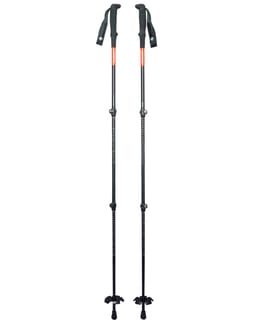
Trekking poles are first chosen by their length and adjustment system, then by weight, which varies with the material. Next comes the number of sections and whether the pole can be folded and stowed quickly in your pack. The quality of accessories is also key: ergonomic cork, foam or EVA grips, comfortable straps, and tungsten tips that make all the difference on wet rock and icy ground.
Carbon vs aluminium poles
Carbon stands out for its remarkable lightness and ability to absorb vibrations, making it a valuable ally on long distances and fast hikes where every gram counts. Aluminium remains a top choice for those prioritising durability: it absorbs shocks, bends rather than breaks, and is better suited to technical terrain where poles are heavily used. Each material has its ideal use.
Folding and telescopic poles
There are two main types on the market. Telescopic models, with 2 or 3 sliding sections, offer continuously adjustable length and adapt in seconds to changing gradients. Folding poles collapse into 3 or 4 sections like a tent pole, offering minimal bulk-ideal for hikers who attach their poles to their pack on pole-free sections. For everyday versatility, telescopic poles remain the most comfortable companion.
Popular trekking pole brands
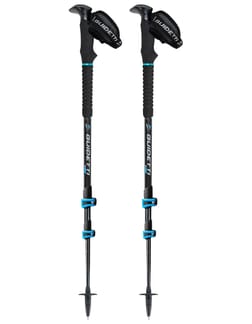
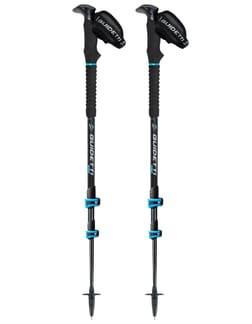
Our selection features brands renowned for their expertise and commitment to the mountain world. Guidetti, a French manufacturer rooted in the Alps, has cultivated decades of craftsmanship, appealing to hikers who value locally made products with refined finishes and proven construction. In a different style, Black Diamond represents the North American school of technical poles: the Colorado brand is a benchmark thanks to its FlickLock system and its Trail, Pursuit and Trail Vista Shock ranges, covering everything from family walks to high mountain adventures. TSL Outdoor offers a premium French alternative with poles like the Tour C5 Cross, designed for trekking and light mountaineering, recognised for their ergonomic design. Finally, Leki is a must-mention, the German brand whose expertise shines on trails and slopes alike, with patented innovations such as the Vario quick-lock system.
Tips for maintaining your trekking poles
Cleaning and storage
Well-maintained poles last for years, provided you follow a few simple steps after each outing. Rinse the sections with clean water to remove mud, dust and salt residue, which can be particularly harsh on locking systems. Dismantle the sections before letting them air dry completely: residual moisture is the main cause of internal seizing. Store your poles away from heat, slightly extended, to avoid stressing the locking mechanisms over time.
Repairs and spare parts
Leading brands generally offer a wide range of accessories and spare parts, allowing you to repair rather than replace: tungsten tips, summer and snow baskets, straps, and complete locking systems. Replacing a worn tip or cracked basket significantly extends the life of your poles, supporting a sustainable approach that benefits both your budget and the mountains.
FAQ about trekking poles
What length should my trekking poles be?
The general rule is that your forearm should form a 90° angle when holding the pole vertically with the tip on the ground. For a numerical guide, multiply your height in centimetres by 0.68. This gives the reference length for flat ground, which you can then adjust for the terrain:
- Uphill: shorten by 5 to 10 cm for better propulsion
- Downhill: lengthen by the same amount to absorb impacts on the knees
- Traverses: adjust each pole independently to match the slope
How do I adjust the height of my poles?
On a telescopic pole, loosen the locking system-whether it's a twist or FlickLock type-then set the desired length using the printed graduations on the section. Tighten firmly but without forcing. A “STOP” mark is always shown on the lower section: never go beyond it, as this could weaken the pole. Precise adjustment is the best way to prevent shoulder tendinitis and lower back pain on long hikes.
What accessories are compatible with trekking poles?
Modern poles are highly modular, accepting a wide range of interchangeable accessories for different seasons and terrains:
- Summer baskets for dry, rocky trails
- Snow baskets, wider, for winter outings and snowshoeing
- Rubber tips for tarmac and rocky slabs
- Replacement straps and tungsten tips to extend lifespan
Most of these items are compatible across brands, but always check the diameter and thread before buying. For more advice and to refine your choice, see our selection of the best trekking poles for your adventures on the Snowleader blog. Our team is also available via live chat and our detailed FAQ for personalised advice.


Sign up for our newsletter
Be the first to hear about promotions, sales, special offers, snowleader events, and new brands added to our catalog!
By signing up for our newsletter, you agree to receive our personalized emails and to allow us to track whether you open them. You can change your consent at any time after you first receive a communication, or after creating your account, if applicable.


